springbrand deepseek harness
Open-source agent framework where every function is a pluginBuild and run AI agents locally with a plugin-based runtime
Highlights
What you can do with it
- A dev team builds a code agent by plugging in analysis and debugging tools
- Researchers compare models by swapping configured model APIs
- A company embeds the agent loop into an internal assistant platform
How to use it
- 1 Install Node.js and get a model API key
- 2 Run npx deepseek-ai-dsh web in the command line
- 3 Open http://127.0.0.1:3080 in your browser
- 4 Add or replace plugins and configure model APIs as needed
Who it is for
Pros
- Free of charge and open source under the MIT license
- Runs locally without waiting for access
- Flexible plugin system for models and tools
Limitations
- It is still in developer preview, so expect rough edges
- Setup needs Node.js and a model API key, so it is technical
- It does not host models, so you bring your own API access
What DeepSeek Harness is
DeepSeek Harness, shortened to dsh, is an open-source agent framework from DeepSeek AI, built on the Cordis kernel. Instead of a fixed feature set, it packages models, tools, sessions, sandboxes, and agent loops as replaceable plugins, so you can add or swap functions without touching the core. It is free of charge, uses the MIT license, and is still in developer preview. It runs locally with a single command and gives you a Web UI at a local address, which makes it a fit for teams and developers who want to own their agent runtime.
What you can do with it
- Add, remove, or replace plugins for models, tools, sessions, and agent loops.
- Run the whole framework locally and work through a browser Web UI.
- Call different model APIs by configuration instead of hosting models yourself.
- Use an append-only session log to debug and trace what an agent did.
Who it is for
- Teams that want to control their agent runtime without a closed service.
- Plugin developers who build and publish plugins for the framework.
- Model evaluators who need a stable, minimal tool surface to compare models.
- Internal platform teams embedding an inspectable agent loop in their products.
What to watch out for
The project is in developer preview, so expect breaking changes, incomplete docs, and rough edges as versions move. Setup is technical: you need Node.js and a model API key, and you configure plugins and models yourself. It does not host or train models, so you bring your own API access and its costs. Because the code and license can evolve, check the current repository before you build something long-term on it.
FAQ
Is DeepSeek Harness free?
Yes. It is free of charge and open source under the MIT license.
What do I need to run it?
You need Node.js installed and a model API key, then run the start command and open the local Web UI.
Does it host the models?
No. It does not train or host models; it calls the model APIs you configure.
What should I keep in mind?
It is in developer preview, so features may change and you should expect a technical setup.
Why it is free
What the official page says: free of charge
Free limits, trial length and features are decided by the official site and can change at any time.
Product preview
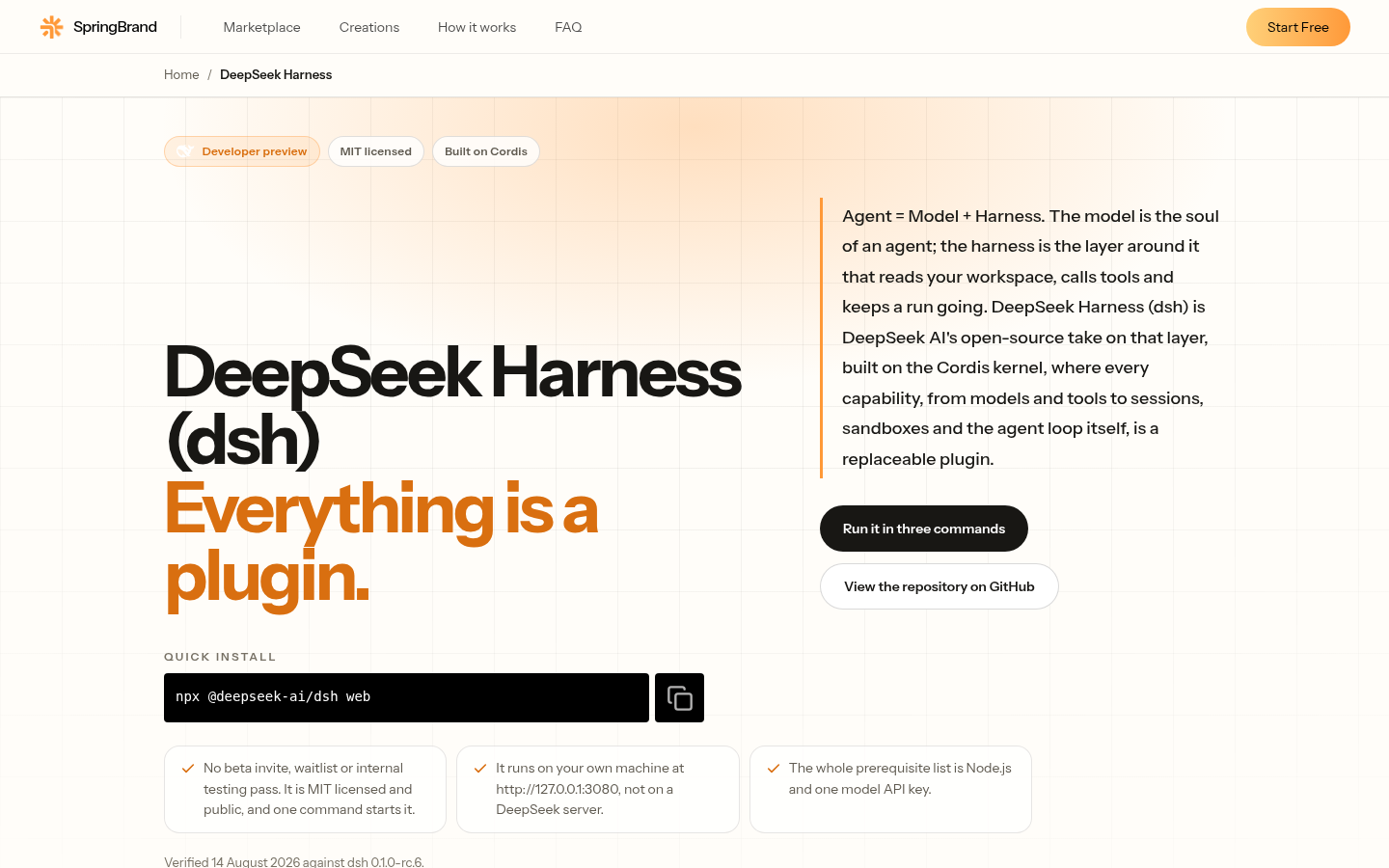
Screenshot archived from the listing page, for preview only.