
Qdrant
Open-source vector search engine in RustFast, scalable vector search for AI apps
Highlights
What you can do with it
- Building semantic search over a large document or product catalog
- Powering retrieval for AI assistants and recommendation systems
- Running vector search on your own infrastructure for data control
How to use it
- 1 Start with the free trial or a local install to test the engine
- 2 Model your data and load vectors with their payloads
- 3 Run similarity queries and tune filters and indexing settings
- 4 Benchmark recall and latency against your own workload
- 5 Move to a self-hosted or cloud deployment that fits your scale
Who it is for
Pros
- Open source, so the code is inspectable and self-hosting is possible
- Real-time indexing and quantization keep search fast and storage manageable
- Deployment options cover local, edge, hybrid cloud, and cloud setups
Limitations
- Running your own vector infrastructure requires operational skill
- Free trial terms may change and paid enterprise tiers are not detailed here
- Getting good recall and latency takes tuning time
- Focused on vector retrieval only; the rest of the AI stack is separate
What Qdrant is
Qdrant is an open-source vector search engine written in Rust. It is built to give AI applications real-time retrieval with the speed, accuracy, and scale those applications demand, whether the workload is semantic search, recommendation, or a retrieval pipeline feeding a language model. The engineering focus is on the hard parts of vector search: keeping indexes current as data changes, storing vectors efficiently, and using advanced quantization to reduce footprint without giving up too much recall. Deployment is flexible. You can run Qdrant locally during development, on a hybrid cloud setup, at the edge, or in a cloud environment, and different versions are offered for enterprise-scale requirements. A free trial is available so teams can measure retrieval quality and latency on their own data before committing. Because the project is open source, teams with strict data residency rules can inspect the code and self-host the engine.
What you can do with it
- Run semantic search across documents, products, or media embeddings
- Power retrieval pipelines for AI assistants and recommendation features
- Filter results with metadata payloads stored next to the vectors
- Deploy the same engine locally, at the edge, or in the cloud
Who it is for
- Developers and machine learning engineers building AI search features
- Teams that must keep embeddings and payloads on their own infrastructure
- Enterprises comparing retrieval engines for production workloads
What to watch out for
Vector search infrastructure is not a plug-and-play product. You need to model your data, load embeddings, tune filters, and benchmark recall and latency against your own workload before you trust the numbers. Self-hosting an open-source engine also means you carry the operational load, including upgrades, backups, and monitoring. The free trial is an evaluation window and its terms may change; paid enterprise versions exist but details vary, so confirm licensing and support terms directly with the vendor. Qdrant covers retrieval only, so embedding models, application logic, and observability remain your responsibility.
FAQ
What language is Qdrant written in?
It is written in Rust.
Can I self-host it?
Yes. It is open source and supports local, hybrid cloud, edge, and cloud deployments.
Is there a free trial?
Yes, a free trial is offered, and different versions are available for enterprise needs.
What is it used for?
Real-time vector retrieval for AI applications such as semantic search and retrieval pipelines.
Why it is free
What the official page says: 免费试用免费
Free limits, trial length and features are decided by the official site and can change at any time.
Product preview
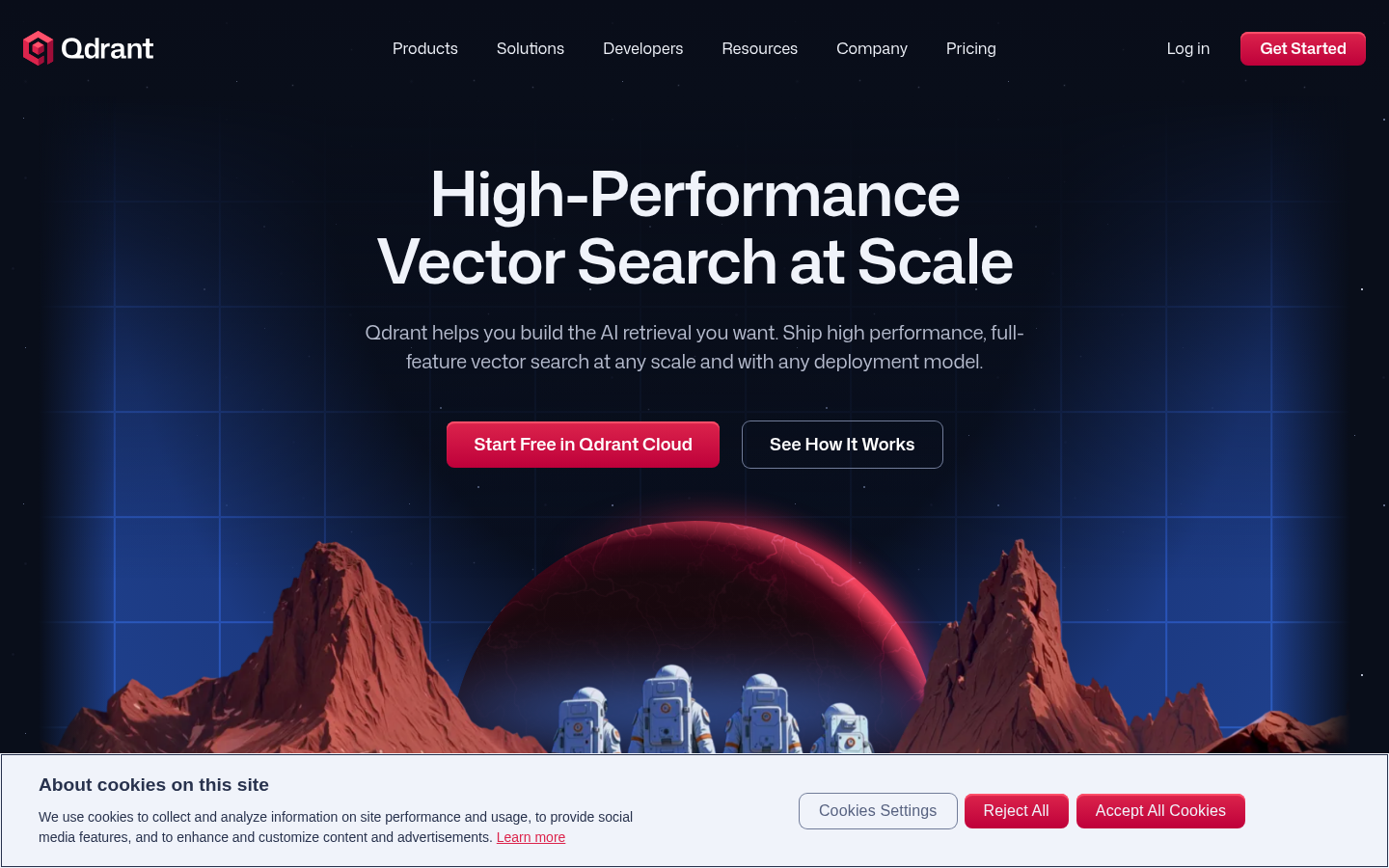
Screenshot archived from the listing page, for preview only.