Polygres
Postgres as AI searchHybrid search on your own data
Highlights
What you can do with it
- AI customer service searching orders and disputes
- Researchers querying records and literature
- Risk models checking transactions and credit data
How to use it
- 1 Create an account on the Polygres website
- 2 Choose a managed instance or connect existing Postgres
- 3 Install the CLI with pip
- 4 Import data and run queries
- 5 Call the API from your application
Who it is for
Pros
- One query returns ranked, merged results
- No context window limits on data size
- Open-source engine with room to customize
Limitations
- Requires database knowledge to set up
- The free trial limits how much you can test
- Performance depends on your data structure
What Polygres is
Polygres is an integrated database platform built and maintained by Evokoa. It transforms a PostgreSQL database into an internal search tool for AI agents. The idea is that agents need to find the right rows quickly, and a single search method is rarely enough, so Polygres runs several methods at once. Full-text search catches exact keywords and codes, vector search catches meaning, graph traversal follows relationships, and scalar filters narrow the set. The results are merged, deduplicated, and re-ranked in one pass so the agent receives a single clean context rather than several lists to reconcile.
What you can do with it
- Run hybrid queries across rows, relationships, and embeddings
- Traverse a compiled graph for multi-hop and shortest-path search
- Combine dense vector, sparse, and full-text search with filters
- Assemble only the context an agent needs
- Deploy a managed instance or connect your own Postgres
Who it is for
- AI developers who need reliable retrieval for agents
- Data scientists working across relational, graph, and vector data
- Enterprise data managers with existing PostgreSQL systems
What to watch out for
This is a developer tool, so expect to install a CLI, import data, and write queries before you see value. The free trial limits how much you can test, and performance depends heavily on your data structure and indexing. Review how context is assembled, since an agent is only as good as the records it retrieves. Behavior may vary across browsers and devices, so test before production use and consult the help docs if errors appear. Features and interface details may change between versions, so review the latest notes on the page before you start.
FAQ
What is Polygres?
It is an integrated database platform that turns PostgreSQL into an internal search tool for AI agents, combining relational, graph, and vector capabilities.
Can I use my own database?
Yes, you can connect an existing PostgreSQL database such as Supabase or Neon, or deploy a managed instance.
What search types are supported?
Dense vector search, sparse and full-text search, graph traversal, scalar filters, and discovery and lookup, all fused into one ranked list.
Why it is free
What the official page says: free trial
Free limits, trial length and features are decided by the official site and can change at any time.
Product preview
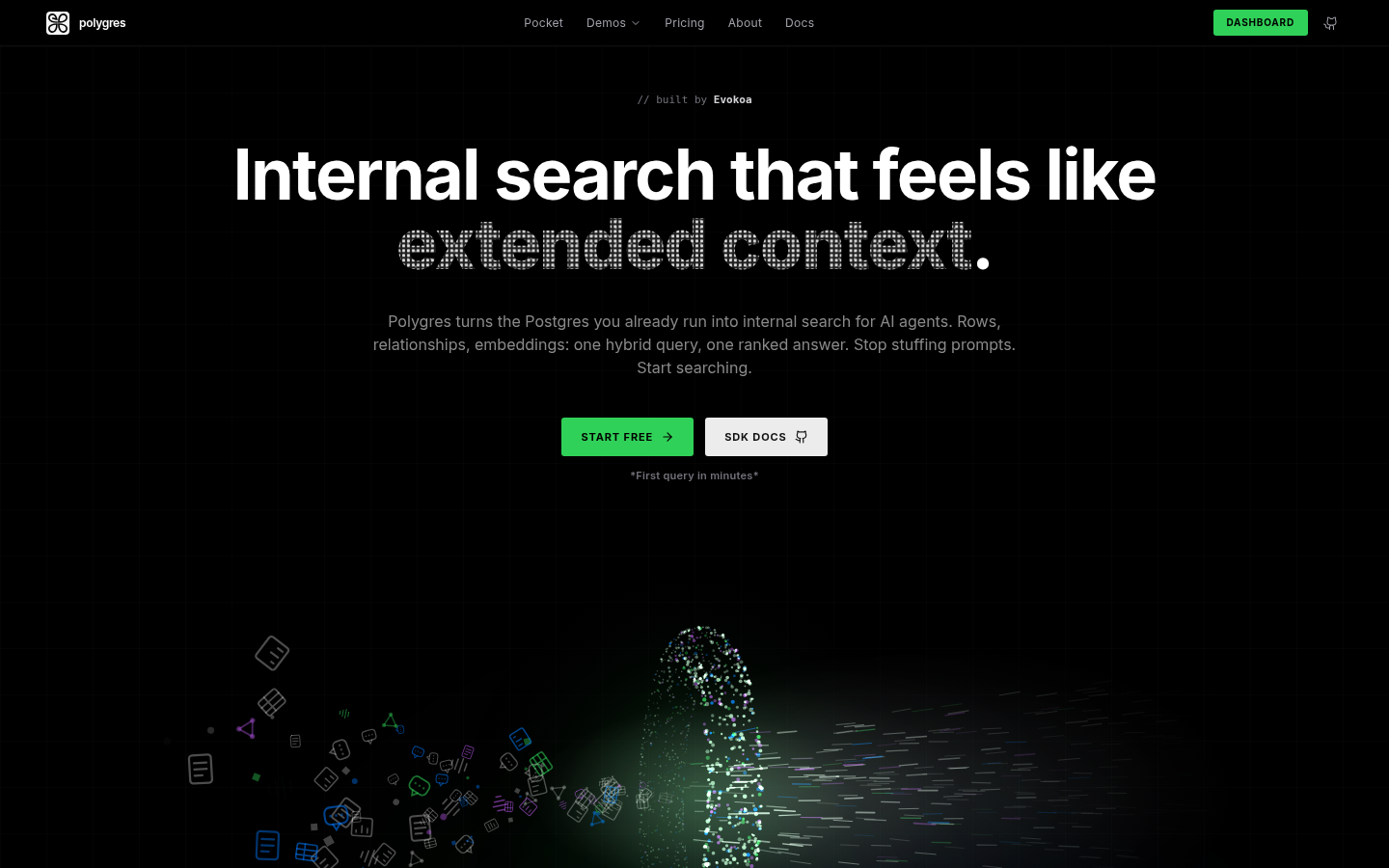
Screenshot archived from the listing page, for preview only.