
Highlights
What you can do with it
- Research teams studying world model architectures
- Robotics and autonomous driving groups evaluating simulation style models
- Developers testing Agora 2 or PROWL 2 in experiments
- Companies tracking progress in interactive world simulation
How to use it
- 1 Visit the site and read the published papers
- 2 Request trial access where it is offered
- 3 Study the documentation for Odyssey 3, Agora 2, and PROWL 2
- 4 Plan an evaluation that fits your research or product timeline
Who it is for
Pros
- Strong research pedigree and substantial funding
- Several released artifacts, including papers and models
- Trial access lowers the barrier to evaluation
- Clear focus on learning from real world interaction
Limitations
- This is a research lab product, not a polished end user application
- Paid plans are not disclosed, so budgeting is guesswork
- Trial access may be limited or gated
- Early stage models can change or be withdrawn as research moves on
What Odyssey is
Odyssey is an AI lab focused on general world models. Its stated goal is to build causal, multimodal systems that let AI learn physical laws, dynamics, causal relationships, and agent behavior, so machines can understand and simulate the real world rather than just predict text. The company reports $310 million in Series B funding, and its team comes from institutions such as DeepMind, Waymo, Tesla, and Meta. Its flagship product, Odyssey 3, is a foundational world model intended for physical and virtual uses including robotics, autonomous driving, drones, and games. The lab has also launched the multi agent world model Agora 2 and the reinforcement learning framework PROWL 2. It emphasizes learning from real world experience and interaction, publishes open source papers, and offers trial access, with pricing described as mainly free trials and no paid details disclosed.
What you can do with it
- Read open source papers describing the world model research
- Request trial access to evaluate the models directly
- Study Odyssey 3 for robotics, driving, drone, or game style use cases
- Experiment with Agora 2 for multi agent settings and PROWL 2 for reinforcement learning
Who it is for
This is aimed at researchers and engineers rather than general users. AI research teams studying world models, causal learning, or reinforcement learning are the clearest fit. Robotics and autonomous driving groups that need models with a sense of physics and interaction will find the positioning relevant. Companies and labs tracking the state of interactive simulation can use the published papers to compare approaches. Anyone evaluating next generation simulation for games or virtual environments may also find something useful.
What to watch out for
Odyssey is a research lab, so expect papers, demos, and trial access rather than a finished product with a dashboard and a support desk. Paid plans are not disclosed, which makes long term budgeting difficult, and trial access may be limited or granted selectively. Early stage models can change quickly or be withdrawn as research moves, so anything you build on them should tolerate that. Finally, the claims about understanding and simulating the world are research goals, not guarantees, so evaluate results on your own tasks before relying on them.
FAQ
What is Odyssey?
An AI lab working on general world models that learn physical laws, dynamics, and causal relationships.
What has it released?
The Odyssey 3 foundational world model, the Agora 2 multi agent world model, and the PROWL 2 reinforcement learning framework.
Is there a free trial?
Trial access is offered and papers are published as open source; paid details are not disclosed.
Who is behind it?
A team with experience at institutions such as DeepMind, Waymo, Tesla, and Meta, backed by $310 million in Series B funding.
Why it is free
What the official page says: 免费试用免费
Free limits, trial length and features are decided by the official site and can change at any time.
Product preview
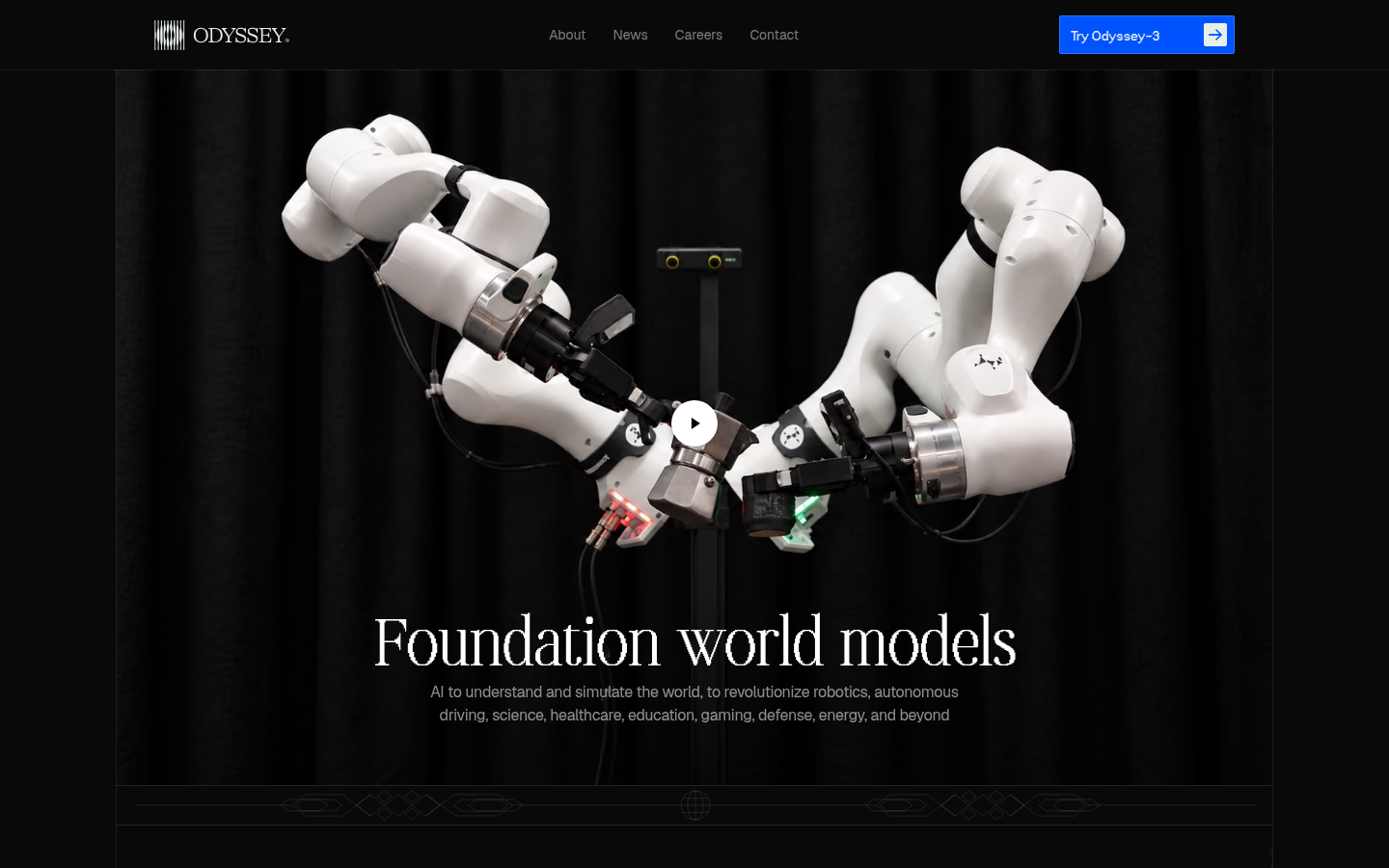
Screenshot archived from the listing page, for preview only.