Lune
MCP knowledge engine giving AI agents full-text access to CS papers.Evidence-based answers for AI agents, straight from papers.
Highlights
What you can do with it
- Graduate students trace foundational papers on topics such as retrieval-augmented generation
- Researchers check whether an idea already exists in prior work before investing
- Writers verify every citation in a related work section before submission
How to use it
- 1 Get the MCP server configuration details from the Lune website
- 2 Add the server in an MCP-compatible client such as Claude or ChatGPT
- 3 Complete authentication, such as providing an API key if required
- 4 Ask research questions in natural language during conversations
- 5 Click citation links to open paper full texts and verify claims
Who it is for
Pros
- Every conclusion comes with clickable citation sources
- Reduces hallucinated claims and open-web noise in research answers
- Works inside AI assistants you already use
Limitations
- Coverage is computer science conferences, so other fields are not included
- Pricing is not publicly detailed, so confirm costs before relying on it
- MCP setup requires some technical configuration
What Lune is
Lune Research is a knowledge intelligence platform built on the Model Context Protocol, designed to give AI agents reliable access to scientific literature. Instead of pulling noisy results from the open web, AI assistants connected to Lune can run full-text semantic search across papers from top computer science conferences such as NeurIPS, ICML, ACL, and SIGCOMM, covering publications from 2020 to the present. Search understands methods and content, not just titles and abstracts, and every answer carries citations users can click to verify. A free trial may be available, though pricing is not publicly detailed, so check the site before committing.
What you can do with it
- Ask questions like "What are the foundational papers on retrieval-augmented generation" and get cited answers
- Track citation chains to see a paper's theoretical roots and its later extensions
- Consult the best practices library for baseline selection, ablation design, and evaluation metrics
- Let AI assistants invoke search and citation tools autonomously during research conversations
Who it is for
- Researchers and graduate students who need to grasp key literature quickly
- AI developers building RAG or agent systems who want grounded, verifiable claims
- Academic reviewers checking novelty and related work coverage
- Science writers and educators who need accurate citations in technical content
What to watch out for
Lune's strength is also its boundary: coverage focuses on computer science conferences from 2020 onward, so older work, preprints, and other disciplines may be missing. Setting up an MCP server requires some technical configuration, and behavior can depend on which AI client you use. Pricing is not publicly specified, so confirm costs and any free trial terms directly, since these can change over time. Finally, citations reduce hallucination risk but do not eliminate it; read the linked sources before relying on a claim in a paper or review.
FAQ
Which conferences does Lune cover?
It includes papers from dozens of top-tier computer science conferences such as NeurIPS, ICML, ACL, and SIGCOMM, from 2020 to the present.
How does it connect to my AI assistant?
Lune runs as an MCP server. You add it in an MCP-compatible client such as Claude or ChatGPT and complete authentication.
Does it prevent hallucinations?
AI agents answer based on retrieved paper full texts, and every conclusion carries citation sources you can click to verify.
Why it is free
What the official page says: free trial
Free limits, trial length and features are decided by the official site and can change at any time.
Product preview
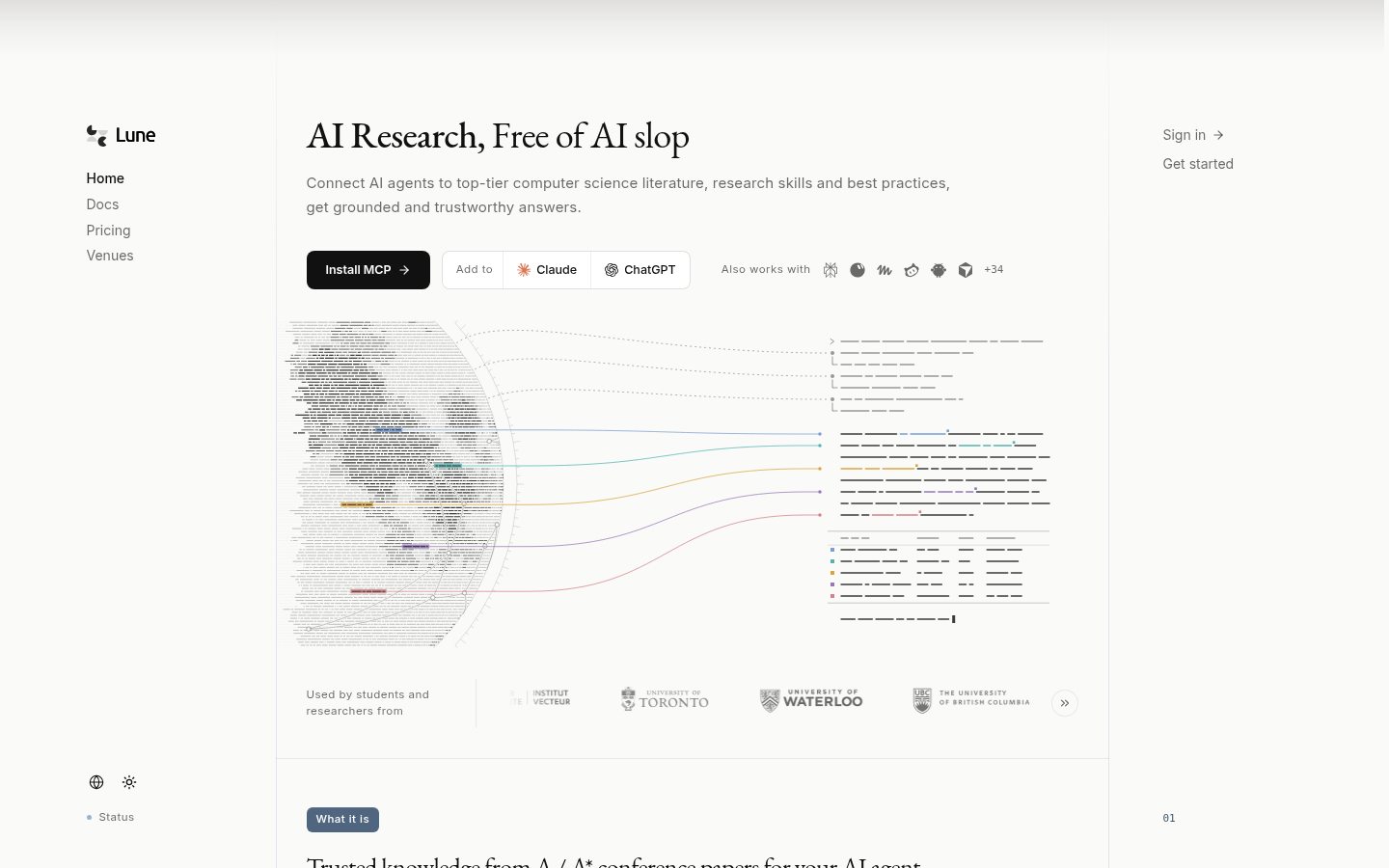
Screenshot archived from the listing page, for preview only.