GitNexus (Akon Labs)
Code intelligence graph for AI agentsEvery dependency and call chain, indexed
Highlights
What you can do with it
- An AI agent using GitNexus solved 68.4 percent of the DeepSWE benchmark, up 31.4 percentage points
- Enterprise teams check which symbols and flows a change will affect before editing
- Developers query hundreds of repositories as one graph to get code context fast
How to use it
- 1 Get GitNexus, either the open-source version or by applying for the enterprise edition
- 2 Run repository indexing so Tree-sitter can parse files and build the knowledge graph
- 3 Review functional clusters produced by the Leiden algorithm to understand the architecture
- 4 Use change analysis while editing to see downstream callers and affected flows
- 5 Combine repositories for cross-repo impact analysis when systems depend on each other
Who it is for
Pros
- Gives AI agents fuller code context so less is missed
- Reduces the number of tokens that need processing
- Compilation-level static analysis rather than guesswork
- Free open-source version to start with
Limitations
- Enterprise version pricing is not published in the documentation
- Setting up indexing and interpreting the graph takes technical skill
- Results depend on how cleanly the repository is structured
- Open-source availability and terms may change over time
What GitNexus is
GitNexus is a code intelligence tool from Akon Labs, backed by Y Combinator. It takes any code repository and indexes it into a knowledge graph that includes every dependency, call chain, functional cluster, and execution process. Files are parsed with Tree-sitter, and imports, call chains, field types, and return types are resolved deterministically rather than guessed. Symbols are grouped into functional clusters with the Leiden community detection algorithm and scored on cohesion and modularity, which helps you see the real shape of the code. An open-source version is free to use, and an enterprise version is offered for organizations that need more. The stated goal is simple: make sure AI agents do not miss key code when they work on a repository.
What you can do with it
- Index a repository so imports, call chains, and types become a queryable graph
- Group symbols into functional clusters to understand the architecture
- Check the impact of a change before you commit it, including downstream callers
- Combine several repositories into one graph and query them together
Who it is for
- Developers who keep getting lost in large or unfamiliar code bases
- AI agent developers who need dependable code context for their tools
- Enterprise teams that maintain many repositories with cross dependencies
- Platform teams that want impact checks wired into code review
What to watch out for
The enterprise edition pricing is not published in the documentation, so budget planning needs a conversation with the vendor. Setting up indexing and learning to read the graph takes technical skill, and the value you get depends on how cleanly the repository is structured, since inconsistent code produces a noisier graph. Open-source availability and terms can also change over time, so teams that build on it should track upstream releases. Treat the benchmark numbers as a reference point from the vendor, not a promise about your own project.
FAQ
What problem does GitNexus solve?
AI agents often miss code context because they only see a few files. GitNexus indexes the whole repository into a knowledge graph of dependencies, call chains, clusters, and flows so the agent sees the bigger picture.
Is there a free version?
Yes, an open-source version is available for free use, and an enterprise version is offered as well. Pricing for the enterprise edition is not stated in the documentation.
How does it analyze code changes?
When you edit code, it tracks each downstream caller, groups them by depth with confidence scores, and maps the git diff to the execution processes that are affected.
Does it work across several repositories?
Yes. Multiple repositories can be combined into a unified graph, with cross-repository edges connecting APIs and their consumers, and the graph can be queried as one unit.
Why it is free
What the official page says: for free
Free limits, trial length and features are decided by the official site and can change at any time.
Product preview
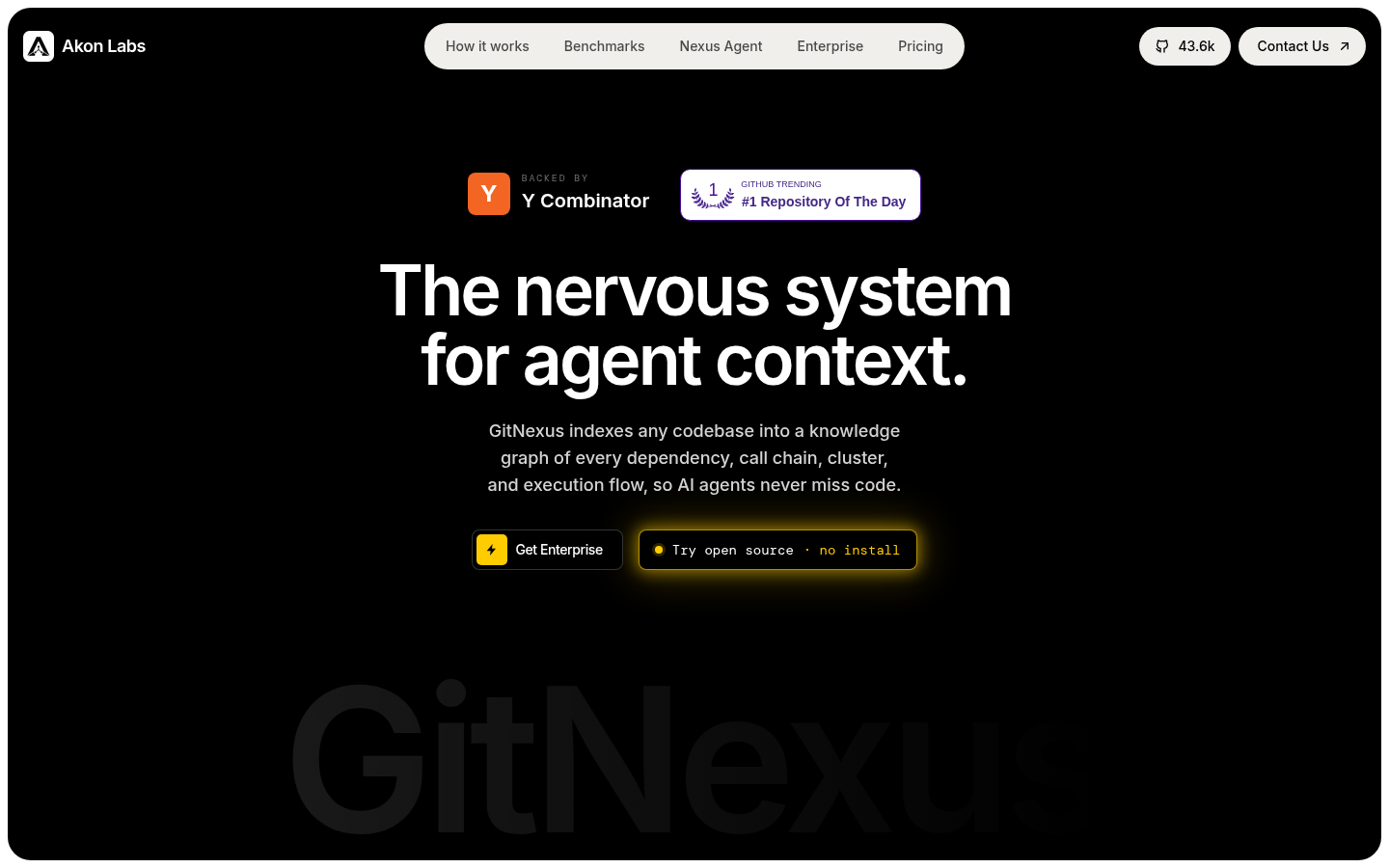
Screenshot archived from the listing page, for preview only.