Epigram
Free AI news aggregatorOpen source AI news summaries
Highlights
What you can do with it
- Following a major global story through short summaries
- Tracking the latest findings in a specific research field
- Finding news leads and background for a story
- Building a daily reading habit without opening twenty tabs
How to use it
- 1 Visit the Epigram website
- 2 Browse the recommended summaries on the homepage
- 3 Click a headline to read the detailed content
- 4 Use search to find news on a specific topic
- 5 Adjust recommendation preferences in user settings
Who it is for
Pros
- Free and open source, so the process is transparent
- Summaries save time on long articles
- Multiple sources and languages in one feed
- Real time updates keep the feed current
Limitations
- Summaries can drop nuance from the original reporting
- Recommendations depend on what you click, which can narrow your view
- A young project can change or shift focus
- Source selection and translation quality vary
What Epigram is
Epigram is an open source, free, AI driven news aggregation platform. The listing describes it as an answer to information overload: instead of opening dozens of sites, you get concise summaries of what happened. It integrates news content from multiple sources so you see a broader picture, then uses AI to analyse and filter that content down to the key information. Because the project is open source, the description says users can inspect how it operates and how it processes data, which is unusual for a news aggregator and matters if you care about why a story surfaced. Other listed features include personalised recommendations based on reading habits, multi language support, real time updates, and a feedback mechanism so users can help shape what the platform shows.
What you can do with it
- Read short AI summaries of news from several sources.
- Follow a major story without opening every article.
- Search for news on a specific topic or keyword.
- Look at the open source code to see how the pipeline works.
Who it is for
- General readers who want key points instead of full articles.
- Researchers tracking new developments in a specific field.
- Journalists hunting for leads and background material.
- Anyone trying to cut through a noisy news cycle.
What to watch out for
A summary is a compressed version of someone else's reporting, and compression loses detail. If a story matters, read the original article rather than relying on the short version, especially for numbers, quotes, and legal or medical claims. Personalised recommendations learn from what you click, which can quietly narrow the range of stories you see, so it is worth searching outside your usual topics now and then. The project is young in the listing, which means features, sources, and focus can shift quickly. Automated aggregation also depends on upstream sites staying reachable and on translation holding up for non English sources. Treat it as a starting point for reading, not as the final word.
FAQ
Is Epigram free?
Yes, the listing describes it as an open source, free, AI driven news aggregation platform.
How does it summarise news?
It uses AI to analyse and filter news content and generates concise summaries of the key information.
Can I see how it works?
The description says the platform is open source, so users can view its operational mechanisms and data processing.
Does it support other languages?
The feature list mentions multi language support for users in different regions.
Why it is free
What the official page says: 免费
Free limits, trial length and features are decided by the official site and can change at any time.
Product preview
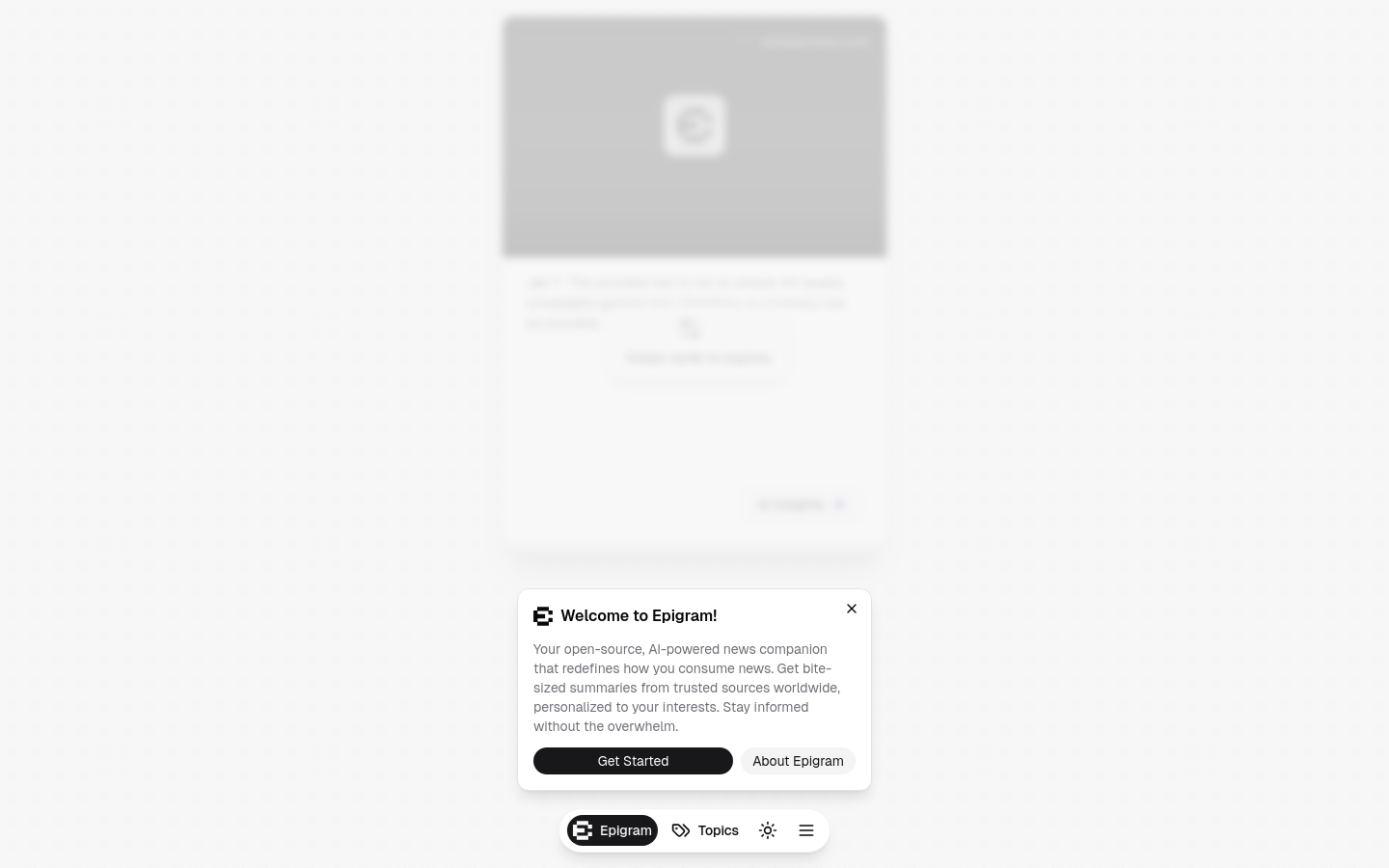
Screenshot archived from the listing page, for preview only.