EntityMatcher
Automate data matching and cleaningMatch, transform, and tag records automatically
Highlights
What you can do with it
- Clean duplicate or messy enterprise records
- Standardize product data for an online store
- Organize survey or research data into categories
How to use it
- 1 Start with the free credit allowance
- 2 Load your records through the API or no-code screen
- 3 Review the automatic matches and tags
- 4 Give feedback to improve accuracy over time
Who it is for
Pros
- Automates matching, extraction, and tagging
- Works for both developers and business users
- Free credit to start before paying
Limitations
- Past the free limit it costs per 10 records
- Accuracy needs human review and feedback
- Match quality depends on how messy the data is
What EntityMatcher is
EntityMatcher is a tool that automatically matches, transforms, and classifies data. It can tell whether two records describe the same entity, pull and format several values out of a record, and tag or categorize records on its own. Both developers and business users can work with it through a REST API or a no-code interface, and there is a simple screen for reviewing what the automation produces. It charges after a free credit limit is used, at 0.01 dollars per 10 records, with bulk discounts for heavy use. It is built for teams that need to clean messy data at scale, and human feedback helps it improve over time.
What you can do with it
- Decide whether two records are the same entity.
- Pull and format multiple values from each record.
- Tag and categorize records automatically.
- Review the output through an API or a no-code screen.
Who it is for
- Data teams cleaning large record sets.
- E-commerce teams standardizing product data.
- Researchers organizing mixed built-in informations.
What to watch out for
Past the free credit limit it costs money per 10 records, so a very large job can add up, though bulk discounts help heavy users. Accuracy needs human review and feedback, because automatic matching can be wrong on edge cases, and you should check the output before you trust it. Match quality depends on how messy the source data is, so very inconsistent records give weaker results. The site status in the source data is unstable, so access can be interrupted. Run one full task end to end first, then expand once you are comfortable with the workflow and the result quality.
FAQ
What does EntityMatcher do?
It automatically matches, transforms, and classifies data records.
How do I use it?
Through a REST API or a no-code interface.
How is it priced?
Free credits first, then 0.01 dollars per 10 records, with bulk discounts.
Why it is free
What the official page says: 免费
Free limits, trial length and features are decided by the official site and can change at any time.
Product preview
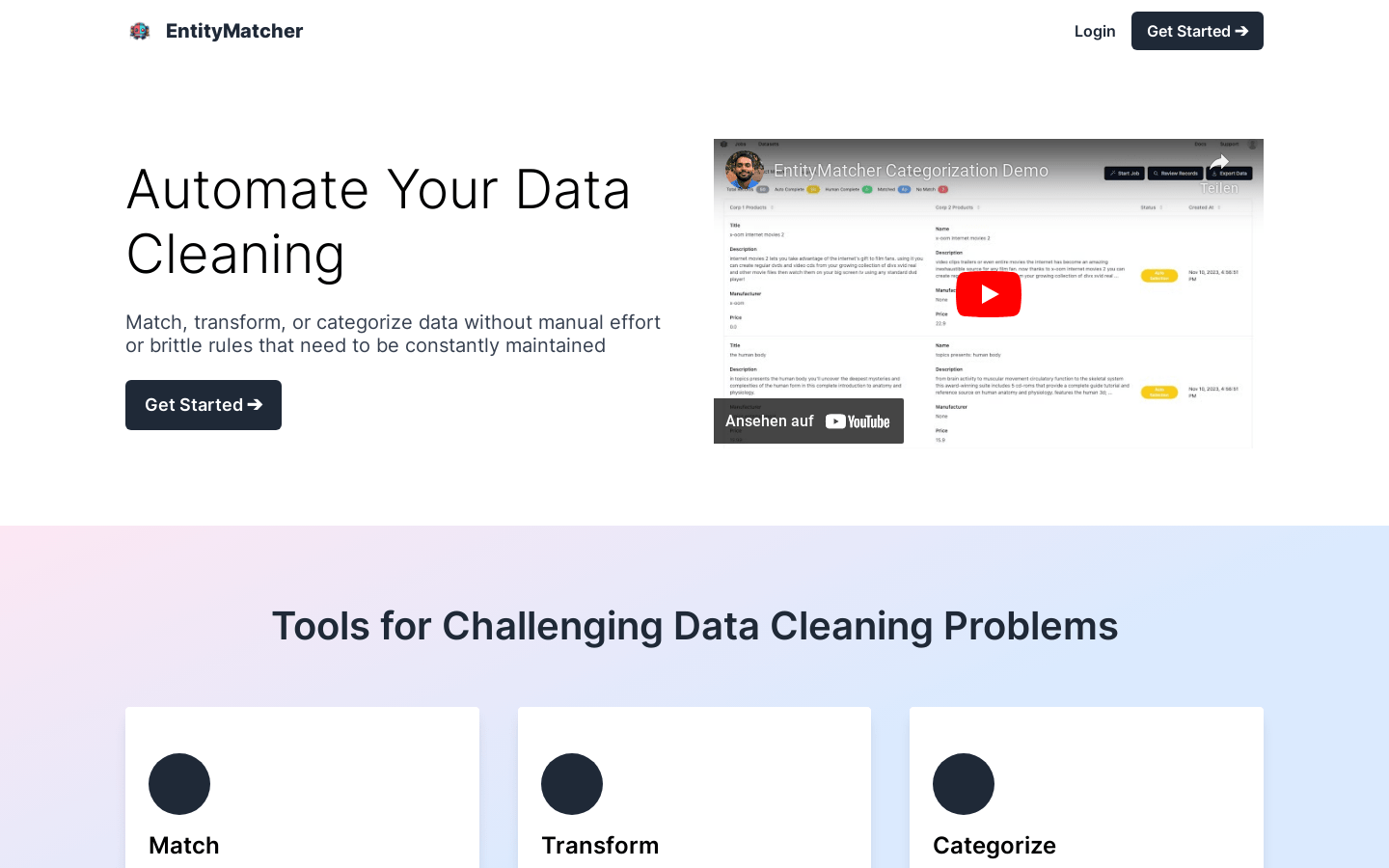
Screenshot archived from the listing page, for preview only.