Data Commons
Free public data platform from GoogleExplore global public data in one knowledge graph
Highlights
What you can do with it
- Tracking sustainable development indicators
- Researchers comparing economic data across countries
- Educators assessing regional education and resource data
How to use it
- 1 Visit datacommons.org and pick a data topic
- 2 Explore the knowledge graph to understand relationships
- 3 Use map, scatter, or timeline tools to visualize
- 4 Download data for local analysis
- 5 Check the docs for API access if you need programmatic queries
Who it is for
Pros
- Free to access with no payment required
- Standardized data across many sources
- Built in visualization and download tools
Limitations
- There is a learning curve to the graph model
- Coverage varies by topic and region
- Programmatic use requires reading API documentation
What Data Commons is
Data Commons is a public data platform started by Google. Public statistics are scattered across agencies and reports, so the platform pulls them into a unified knowledge graph where places, people, and measurements connect. That standardization is the main advantage: instead of cleaning and merging files yourself, you query a graph that already links related data. Access is free, which keeps the barrier low for researchers, analysts, policymakers, and educators.
What you can do with it
- Explore data structure and relationships in the knowledge graph
- Compare statistics across regions with map visualization
- Check correlations with the scatter plot explorer
- Track trends over time with the timeline explorer
- Download data for local analysis or use the API
Who it is for
- Researchers and analysts who need reliable public statistics
- Policymakers and public sector teams tracking indicators
- Educators and students teaching or learning with real data
- Organizations like the UN that monitor global progress
What to watch out for
Free access does not mean effortless use. The knowledge graph model takes time to learn, and coverage varies by topic and region, so not every statistic you want will be there. If you need programmatic access, budget time to read the API documentation. Finally, public data changes as sources update, so cite the retrieval date and re check figures when you publish. Processing speed depends on file size and network conditions, so retry later if a task stalls during peak hours. Run one full task end to end first, then expand once you are comfortable with the workflow and the result quality. Generated suggestions are for reference only, so verify anything that affects professional judgment or important data.
FAQ
What is Data Commons?
It is a Google initiated public data platform that unifies global public data into a knowledge graph.
Is it free?
Yes. Data Commons is free to access.
What tools does it offer?
It offers a knowledge graph explorer, data download, map, scatter plot, and timeline visualization, plus an API.
Why it is free
What the official page says: 免费
Free limits, trial length and features are decided by the official site and can change at any time.
Product preview
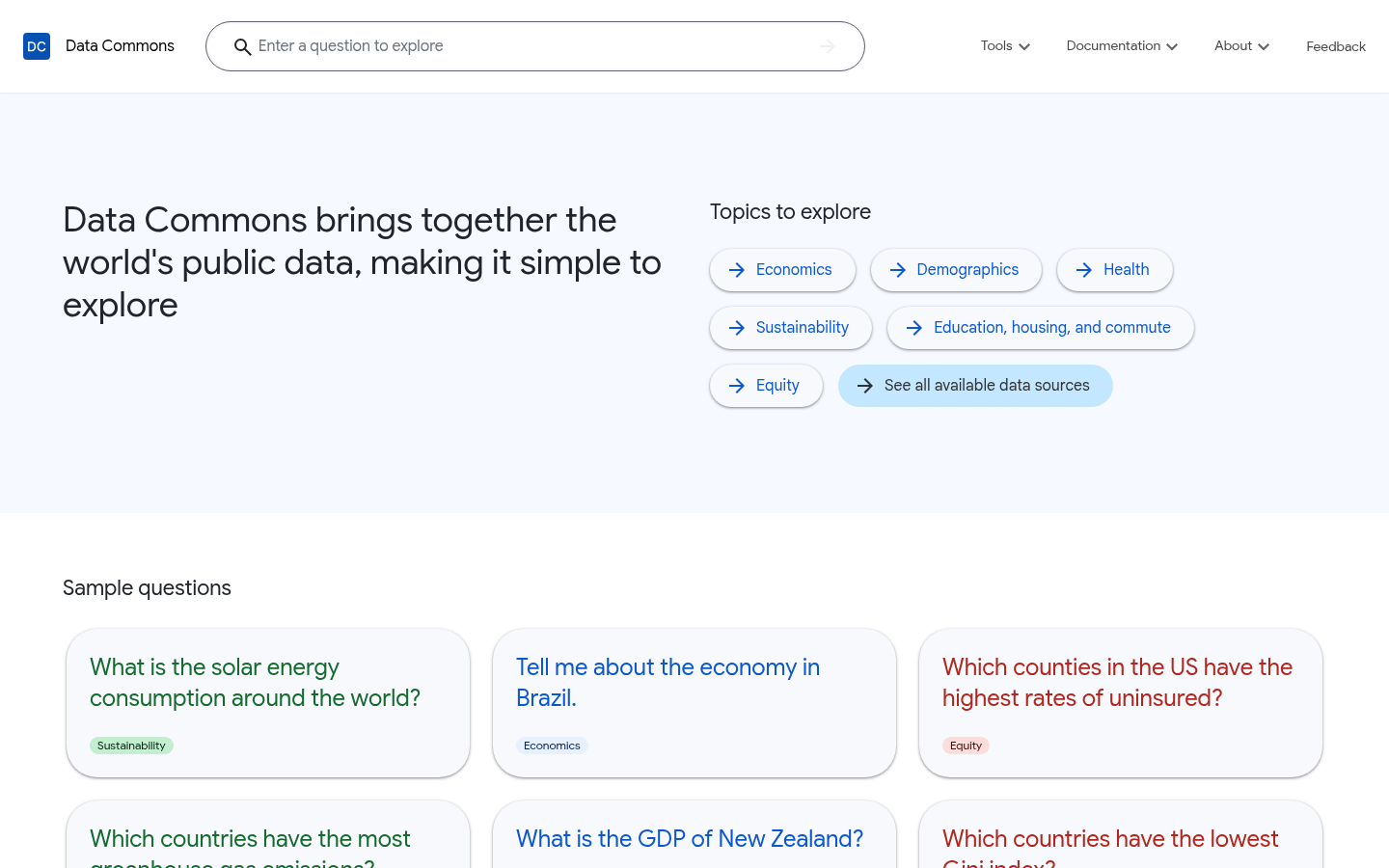
Screenshot archived from the listing page, for preview only.