CortexPrism
Open-source self-hosted agent operating system for autonomous AI agents.Turn any LLM into an autonomous agent, free and self-hosted.
Highlights
What you can do with it
- Enterprises building intelligent customer service on AI agents
- Research institutions automating data processing in a sandbox
- Developers creating intelligent task scheduling with team collaboration
How to use it
- 1 Visit cortexprism.io and download the version for your system
- 2 Configure parameters such as your LLM provider and memory setup
- 3 Develop agents using the built-in tools and functions
- 4 Deploy agents and manage them with multi-user collaboration and federation
Who it is for
Pros
- Genuinely free and open source, including commercial use under Apache 2.0
- No lock-in to a single LLM vendor across 30 providers
- Security architecture and sandboxing designed in from the start
Limitations
- Self-hosting an agent OS demands real DevOps and security competence
- Model API costs are separate and can grow quickly with autonomous agents
- Documentation maturity and community size are still developing
What CortexPrism is
CortexPrism is an open-source agent operating system built on Deno and licensed under Apache 2.0, positioned as a platform for developers and enterprises to build, deploy, and manage autonomous AI agents. Its core promise is turning any large language model into a capable autonomous agent, and it backs that with substantial infrastructure: support for 30 LLM providers so teams choose models by capability and budget, a 5-layer persistent memory system that lets agents retain context across sessions, and more than 60 built-in tools covering data processing, task scheduling, and beyond. Code execution happens in a secure sandbox to contain risky operations. Collaboration is built for teams: multi-user development, team federation, and an MCP plugin market where developers share and install extensions. Security gets dedicated treatment through the enterprise-level Parallax architecture with an LLM monitor watching agent behavior in real time. The platform itself is free, though the LLM APIs you connect will have their own costs.
What you can do with it
- Build autonomous agents on top of any of 30 supported LLM providers
- Run code safely inside a sandbox and use 60-plus built-in tools
- Extend agent capabilities through the MCP plugin market
- Collaborate across users and teams with federation and shared management
Who it is for
- AI developers who want powerful tooling without vendor lock-in
- Enterprise users deploying and managing agents across teams
- Research institutions running experiments and automated data analysis
- Teams that need self-hosting and open-source licensing for compliance reasons
What to watch out for
Free and open source does not mean cost-free in practice: you will pay each LLM provider for API usage, and autonomous agents that loop and call tools can consume tokens at surprising speed, so set usage limits and monitor spend. Running a self-hosted agent operating system also assumes real DevOps capability; you own the deployment, updates, and security posture of your instance, and the Parallax architecture helps but does not replace good operational hygiene. Because the project is young, documentation and community resources are still maturing, so expect to solve some problems independently. Sandbox and monitoring features reduce risk but do not eliminate it: review what your agents are permitted to do, especially anything touching external systems, and test with least-privilege permissions before granting broader access.
FAQ
Is CortexPrism free?
Yes. It is open source under the Apache 2.0 license, so the platform is free. You still pay your chosen LLM providers for API usage.
How many LLM providers does it support?
30 different large language model providers, letting you choose models based on needs and budget.
What is the memory system for?
The 5-layer persistent memory system stores agent data so agents remember context across sessions and tasks.
Why it is free
What the official page says: 免费
Free limits, trial length and features are decided by the official site and can change at any time.
Product preview
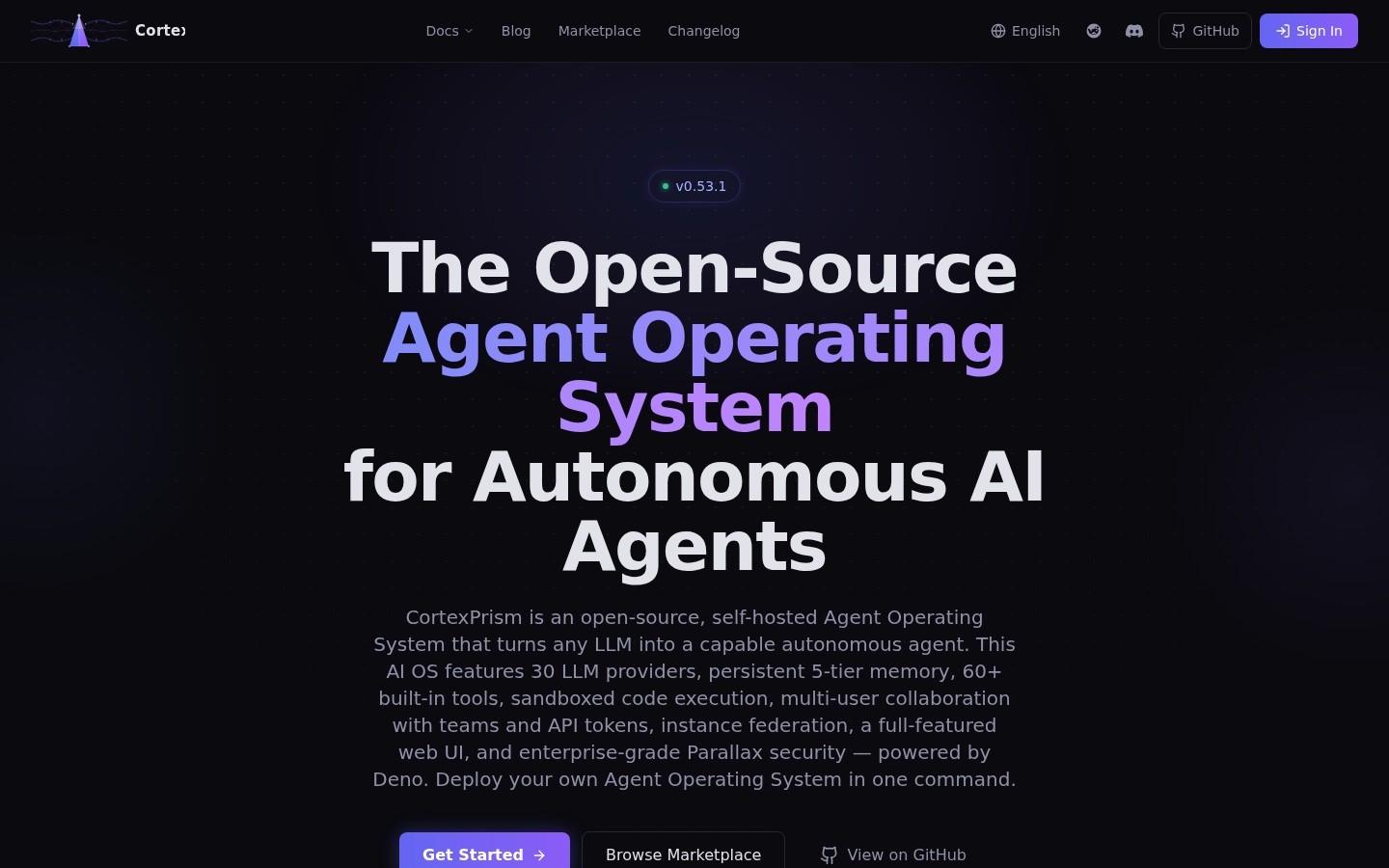
Screenshot archived from the listing page, for preview only.