Archal
Stateful API sandboxesIsolated test environments for AI agents
Highlights
What you can do with it
- An agent developer tests GitHub and Slack integrations before release
- A connector team trials a new payment flow on a Stripe sandbox
- An integration engineer runs a full multi-platform check before an upgrade
How to use it
- 1 Register at archal.ai and complete verification to receive $5 in credit
- 2 Pick the API environments your test needs, such as GitHub, Slack, or Stripe
- 3 Create a sandbox with a known starting state and claim the extra $15 credit
- 4 Call the environments over REST or MCP with your usual paths and payloads
- 5 Inspect requests, responses, and mutations while debugging
- 6 Reset all environments to the declared baseline when the test ends
Who it is for
Pros
- Avoids dirty data and rate limits on real test accounts
- States are resettable, so every run starts from the same place
- Starter credits cover the first experiments
- Uses familiar REST or MCP calls, so no new client to learn
Limitations
- Running environments cost $0.10 per minute, so long sessions add up
- Only the platforms on the supported list are available
- Setup assumes comfort with coding agents and API tooling
- Credits are prepaid, so unused balance sits in your account
What Archal is
Archal is a testing tool built specifically for AI agents that talk to external APIs. The problem it addresses is familiar: test accounts accumulate junk data, hit rate limits, and cannot be trusted to reproduce a failure. Archal gives you isolated sandboxes instead. Each sandbox holds one or more stateful API environments, and you declare a known starting state before the run. During the test, state persists between calls exactly as it would on a live service, so multi-step agent behaviour can be exercised properly. When you are finished, everything returns to the declared baseline, which means the next run starts clean. Pricing is usage-based: $5 on verified registration, another $15 once your first sandbox is ready, then $0.10 per minute per environment, billed by the second.
What you can do with it
- Create isolated sandboxes covering several API environments at once
- Declare a starting state so a test is reproducible from run to run
- Call environments over REST or MCP with paths and payloads you already use
- Watch requests, responses, mutations, timing, and usage while debugging
- Reset every environment to baseline when the test is complete
- Automate registration and setup by pasting skills into Claude Code, Codex, Cursor, or Devin
Who it is for
Agent developers get the clearest benefit, because an agent that chains several API calls cannot be tested honestly against an account that already holds yesterday's data. Connector teams building integrations across many platforms can spin up a sandbox per platform instead of negotiating access to production-like accounts. Integration engineers use it as a pre-flight check before a large upgrade, running a full pass over the environments their system touches. Any team whose agent behaviour depends on API state, rather than on a single stateless request, is in scope.
What to watch out for
Metering is per minute and per environment, so a sandbox with several environments left running all afternoon is a real bill rather than a rounding error; shut environments down when you are done. Coverage is limited to the platforms on the supported list, so an obscure internal API will not appear there. Setup is developer work: you configure environments, drive them through REST or MCP, and read inspection output, which assumes API familiarity. Credits are prepaid, so unused funds simply stay in the account. Failed configurations and cold start time are not charged, which softens the cost of trial and error.
FAQ
How much does Archal cost?
Verified registration gives $5, and a ready first sandbox adds $15. After that each environment costs $0.10 per minute, billed by the second, with failed configurations and cold start time free.
Which platforms can I test against?
The listed environments include GitHub, Slack, Stripe, Apify, and Cal.com, among others.
How do states reset?
When testing is complete you restore every environment in the sandbox to the declared baseline state.
Can I automate the setup?
Yes. Skills can be pasted into tools such as Claude Code, Codex, Cursor, or Devin to automate registration and configuration.
Why it is free
What the official page says: free of charge
Free limits, trial length and features are decided by the official site and can change at any time.
Product preview
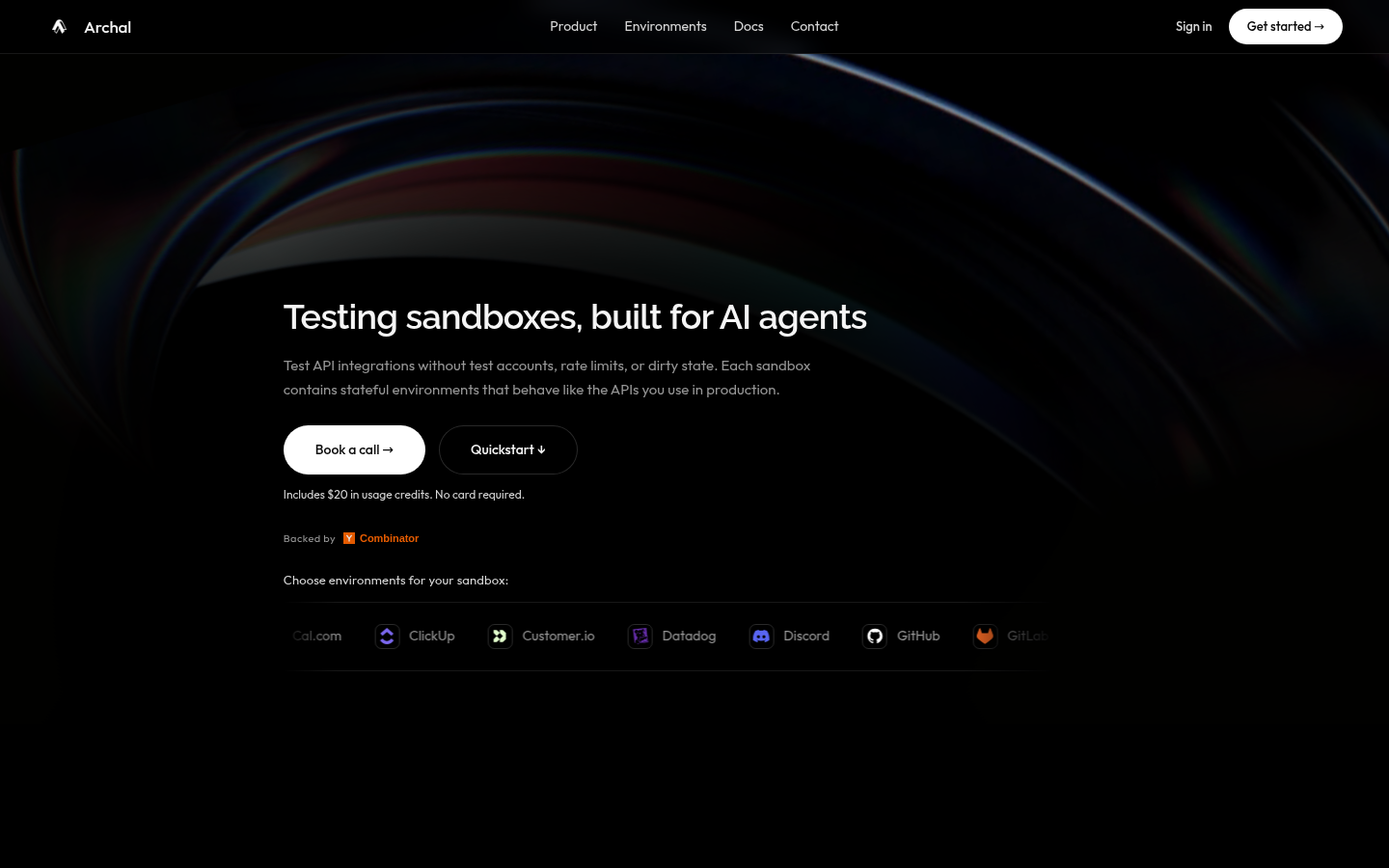
Screenshot archived from the listing page, for preview only.