Acade
AI research assistant for reproducible studiesFrom research question to cited report
Highlights
What you can do with it
- Researchers identifying gaps and planning studies
- Students learning the research process
- Educators designing research-based courses
How to use it
- 1 Enter the research question and context
- 2 Review the literature mapping
- 3 Generate and assess candidate hypotheses
- 4 Plan and run the experiment
- 5 Interpret results and generate the report
Who it is for
Pros
- Free trial before paid tiers
- Traceable sources throughout the cycle
- Structured process from question to report
- AI supports rather than replaces judgment
Limitations
- Paid tiers limit credits and features
- Output quality depends on input clarity
- It assists research but does not guarantee validity
What Acade is
Acade is an application that assists AI research by structuring the whole research cycle. It starts with research question intake, capturing the domain, goals, constraints, relevant documents, and the decisions you expect to make. From there it clusters related papers and maps the claims, debates, and gaps inside them while keeping source information intact. It then generates candidate hypotheses with supporting evidence, counter-evidence, novelty, feasibility, and risk assessments, so you get several directions rather than a single guess. Experiment planning turns a hypothesis into concrete data requirements, baselines, metrics, controls, and risk checks.
What you can do with it
- Capture research questions with full context
- Map literature claims, debates, and gaps
- Generate hypotheses with evidence and risk review
- Plan experiments with data and baseline requirements
- Interpret results and produce an editable cited report
Who it is for
- Researchers who need a reproducible workflow
- Students learning how to run a study
- Educators designing research-based courses
What to watch out for
A free trial is offered, but paid packages such as Plus, Pro, and Team Lab set credit limits and feature access, so heavy use costs money. Output quality depends on how clearly you frame the question and how good the underlying literature is, since a vague brief produces a vague mapping. The tool assists with evidence handling but does not replace scientific judgment, and it cannot guarantee that a study is valid or novel. Generated reports still need human review before they support a real decision or publication, and citations should be checked against the original papers, since automated mapping can occasionally attach a claim to the wrong source.
FAQ
What is Acade?
An app that turns research questions into verifiable research cycles with literature mapping, hypotheses, experiment planning, and reports.
Is there a free trial?
Yes, a free trial is offered, with paid packages such as Plus, Pro, and Team Lab.
Does it replace the researcher?
No. It assists with searching, comparing, and recording evidence, but scientific judgment stays with the user.
Who is it for?
Researchers, students running projects, and educators teaching research skills.
Why it is free
What the official page says: free trial
Free limits, trial length and features are decided by the official site and can change at any time.
Product preview
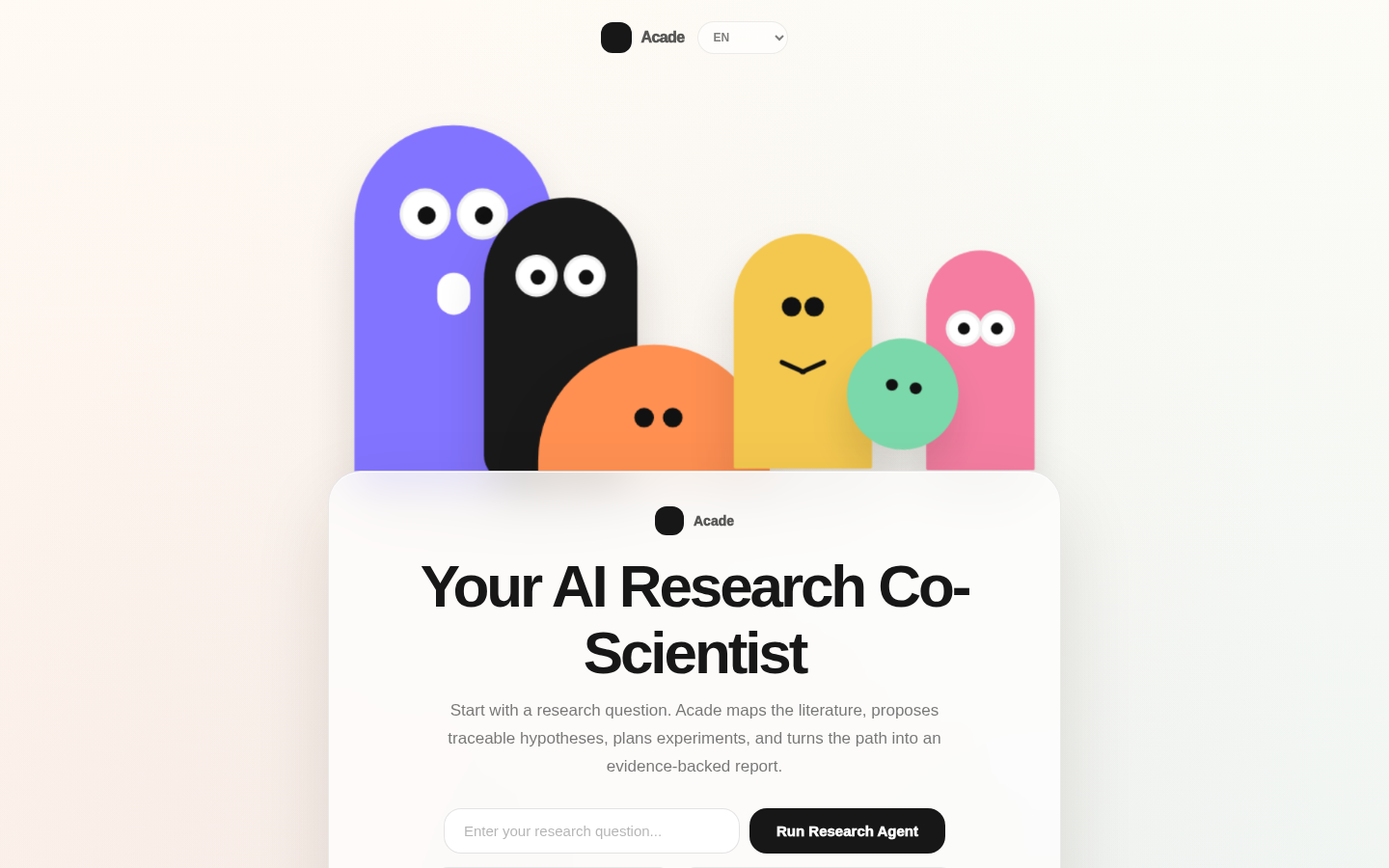
Screenshot archived from the listing page, for preview only.